
Military instructor pilot to FAA flight instructor
How current and former U.S. military instructor pilots and pilot examiners get an FAA flight instructor certificate under 14 CFR 61.73(g): who qualifies, the records that prove it, the MCI knowledge test, the IACRA application and keeping the certificate current afterward.
The short version
If you are or were a U.S. military instructor pilot or military pilot examiner, the FAA can issue you a flight instructor certificate from your military records. There is no practical test and no Fundamentals of Instructing (FOI) test. You need:
- A commercial or ATP certificate with the category and class rating that matches the instructor rating you want
- An instrument rating (or instrument privileges) on that pilot certificate that matches the instructor rating
- A passed MCI knowledge test from the last 24 calendar months, unless you already hold an FAA flight instructor certificate
- Three official military records: that you are or were an instructor pilot or pilot examiner, that you completed the instructor or examiner course, and that you passed an instructor or examiner proficiency check, each in a manned aircraft appropriate to the rating
The rest of this guide walks through each piece and the places applications usually get stuck.
Who qualifies
- Current and former U.S. military instructor pilots and pilot examiners of the Army, Navy, Marine Corps, Air Force and Coast Guard, including the Reserve and National Guard.
- No time limit. There is no limit on how long ago you were an instructor or left the service (5-618B(7)). Neither 61.73(g) nor the FAA guidance puts an age limit on your instructor records. The only item with a clock is the MCI knowledge test.
Who does not
- Foreign military pilots. A pilot of a foreign ICAO state assigned to U.S. pilot duties can get a commercial certificate under 61.73, but not a flight instructor certificate (5-620).
- Anyone removed from flying status for lack of proficiency or for disciplinary action involving aircraft operations (61.73(a)).
- Civilians who instruct for the military. Civilian employees, contractors, police and other government employees cannot use 61.73 based on that employment, even if they instruct military students (5-618B(3)).
- Unmanned aircraft instructors. The instructor course and proficiency check must be in a manned aircraft. UAS or RPA instructor experience does not qualify.
Step 1: The pilot certificate comes first
The instructor certificate is built on your pilot certificate. Under 61.73(g)(1) and (2) you must already hold:
- A commercial or airline transport pilot certificate with the category and class rating for each instructor rating you want. Private pilot privileges on a commercial or ATP certificate do not qualify (5-620A(1)). For example, a commercial airplane multiengine pilot whose single-engine rating is at the private level cannot get a single-engine instructor rating.
- An instrument rating, or instrument privileges, on that certificate appropriate to the instructor rating. An ATP certificate carries instrument privileges.
If you do not hold these yet, the commercial certificate and instrument rating can also come from your military records under 61.73. Both certificates can be done at the same appointment. The FAA treats them as two applications: one for the commercial pilot certificate and one for the flight instructor certificate (5-624A and B). See military competency in IACRA for the pilot certificate application.
Step 2: Match each instructor rating to your records
Each instructor rating stands on its own military instructor qualification in that category and class. The ratings that can be issued are:
| Instructor rating | What your military records need to show |
|---|---|
| Airplane Single-Engine | Instructor pilot or examiner qualification in a single-engine airplane |
| Airplane Multiengine | Instructor pilot or examiner qualification in a multiengine airplane |
| Rotorcraft Helicopter | Instructor pilot or examiner qualification in a helicopter |
| Powered-Lift | Instructor pilot or examiner qualification in a powered-lift |
| Glider | Designation as a glider instructor pilot, or as an examiner qualified to evaluate glider proficiency (5-620D) |
| Instrument Airplane, Helicopter or Powered-Lift | Designation as an instrument instructor pilot, or as an examiner qualified to evaluate instrument proficiency, in that category (5-620C) |
- Student time does not count here. Time from your own pilot training, such as primary training in a single-engine trainer, can add a class rating to your commercial certificate. It does not support an instructor rating. An instructor rating needs an instructor qualification.
- Each rating is separate. A helicopter instructor pilot gets a helicopter instructor rating, not an airplane one. A multiengine airplane instructor gets multiengine, not single-engine.
- The pilot certificate must match too. Your commercial or ATP certificate needs the same category and class, at the commercial level or higher, and the instrument rating for an instrument instructor rating.
Step 3: Gather the three military records
61.73(g)(3) requires official U.S. Armed Forces records or orders showing that you:
- Are or were qualified as a military instructor pilot or pilot examiner for the rating sought
- Completed an instructor pilot or pilot examiner training course and received an aircraft rating qualification as an instructor or examiner, in a manned aircraft appropriate to the rating
- Passed an instructor pilot or pilot examiner proficiency check in a manned aircraft appropriate to the rating
One document can cover more than one of these. Personal logbooks and electronic logbooks can support your records but do not replace them. Here is what the FAA guidance looks for in each branch’s records.
Air Force
- AF Form 8, Certificate of Aircrew Qualification. An initial instructor evaluation is shown as an INSTR evaluation. Recurrent instructor evaluations are usually shown as a QUAL, INSTM or MSN evaluation with IP as the crew position. Instructor-related remarks in the Mission Description or Additional Comments blocks on the back help confirm it (Figure 5-67).
- Grades. Q1 and Q2 are acceptable. Q3 is not. A No-Notice (N/N) evaluation does not count as a proficiency check.
- Supporting records. Aeronautical orders and AF Form 942, Record of Evaluation, are also accepted.
More on Air Force records: U.S. Air Force military competency.
Army
- IP Course or IE Course diploma with DA Form 1059. Block f should name a manned aircraft followed by IP Course, for example “UH-60 IP Course.” The reason for submission should be course completion, the skills marked Met Standards, overall achievement Achieved Course Standards, and Part IV signed (Figure 5-68).
- DA Form 759. The IP, IE and SP columns show instructor time. If you just graduated from the IP or IE Course those columns may be empty. That is fine as long as you have the DA Form 1059 and diploma.
- Unit Trainer/Evaluators (UT/E). A fully qualified UT/E with endorsements dated after July 6, 2022 counts as an instructor pilot. Fully qualified means the UT/E academics, Day and Night modules are complete. Show the module completion entries on DA Form 7122 or DA Form 759, and the UT/E duties endorsed on DA Form 7120. Completing the UT/E Instrument module supports an instrument rating on the instructor certificate (5-620A).
- Instrument instructor. An Instrument Examiner (IE) qualification supports the instrument helicopter instructor rating.
More on Army records: U.S. Army military competency.
Navy and Marine Corps
- Squadron commander’s letter showing your NATOPS instructor pilot or flight examiner designation, or “NATOPS INSTRUCTOR” noted on the OPNAV 3710/7, NATOPS Evaluation Report (5-620A and Figure 5-69).
- “NATOPS qualified” is not enough. It supports a commercial certificate but not a flight instructor certificate. An ordinary line instructor is not the same as a NATOPS instructor.
- Instrument instructor. The OPNAV 3710/2, NATOPS Instrument Rating Request, must state you are “fully qualified for an INSTRUMENT INSTRUCTOR rating.” A special instrument rating recognizes experience and does not make you an instructor.
- Crew position must be PILOT. NFO and aircrew qualifications do not count.
More on Navy and Marine Corps records: U.S. Navy and Marine Corps military competency.
Coast Guard
The FAA’s list of acceptable Coast Guard records is the OPNAV 3710/31, Aviator’s Flight Log Book, with qualifications recorded in its Qualification and Achievements section. The guidance does not name a Coast Guard instructor document, so bring whatever official records show your instructor pilot designation, the instructor course you completed and your instructor check, and send them for review before you apply. See U.S. Coast Guard military competency.
Step 4: Pass the MCI knowledge test
- The test. The Military Competence Instructor (MCI) knowledge test covers the flight instructor knowledge areas in 61.185(a). Take it at an FAA knowledge testing center. You need an FAA Tracking Number (FTN) to register. See getting started in IACRA.
- Valid for 24 calendar months. It must be passed within the 24 calendar months before the month you apply.
- No FOI test. You do not take the FOI test or the regular instructor knowledge test for the category (5-620B(1)).
- No substitutes. Another knowledge test, such as the FOI or a civilian instructor test, cannot be used in place of the MCI (5-620B(2)).
- Already a CFI? If you already hold an FAA flight instructor certificate, you do not need the MCI. The certificate stands in for the test report. The exception is a flight instructor who holds only a sport pilot rating, who must pass the MCI before more ratings are issued (5-620B(3)).
Check the current FAA testing matrix before you schedule.
Step 5: Make the IACRA application
Log in to IACRA as an Applicant and click Start New Application. Choose Instructor as the application type, then Flight Instructor, Standard, CFR 61 - Military Competency.
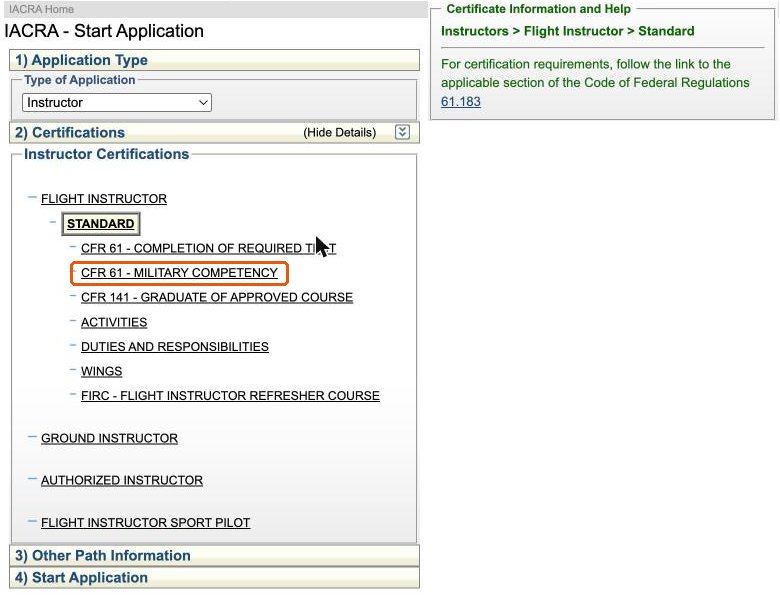
The application works like the military competency pilot application: a pop-up window collects your military service information and another collects the ratings. On the instructor application:
- Military service. Enter your branch, the date you were rated as a military flight instructor or examiner, your rank or grade, and the military aircraft that support each instructor rating (5-624C(2)).
- Ratings. Select only the instructor ratings your records support.
- Knowledge test. Your MCI test is pulled in by your FTN. If you already hold a flight instructor certificate, no test is needed.
- No recommending instructor. No instructor endorsement or recommendation is required (5-624C(4)).
Submit the application, then sign it when its status changes to Ready for Applicant Signature after the examiner retrieves it.
What you receive
- A temporary flight instructor certificate with your category and class ratings and any instrument instructor ratings, issued at the end of the appointment. The permanent certificate is mailed by the FAA.
- A required limitation: “Valid only when accompanied by pilot certificate number [your number].” It is on every flight instructor certificate.
- A recent experience period. Flight instructor certificates issued on or after December 1, 2024 do not expire. Instead, you must establish recent experience every 24 calendar months under 61.197, counted from the month the certificate is issued.
If you already hold an FAA flight instructor certificate
Military instructor qualifications can also add ratings to an existing certificate and keep it current.
Adding ratings
- Your certificate must be in good standing: not surrendered, cancelled, suspended or revoked (5-620E(1)).
- Adding a rating does not reset your recent experience period unless you also meet one of the recent experience requirements. For example, a CFI with an airplane rating whose period ends in March 2026 adds a helicopter rating in January 2025. The period still ends in March 2026 (5-620E(3)).
- Lapsed recent experience. You can still add a rating if you received the new military instructor qualification within the previous 6 calendar months. That adds the rating and reinstates your privileges at the same time (5-620E(2)).
Establishing recent experience
A military instructor pilot or pilot examiner proficiency check passed within the 24 calendar months before the month you apply establishes recent experience under 61.197(b)(2)(iv). The check can be in an aircraft for a rating you hold or for an additional rating. Recent experience and an added rating can go on the same application, as long as both are clearly identified (5-620F(2)).
Timing matters. Apply within the 3 calendar months before the last month of your current period and the new 24 months start from the end of the current period, so you lose nothing. Apply earlier and the new period starts from the month of the application.
For the IACRA steps, see CFI renewal in IACRA.
Reinstating lapsed privileges
If your recent experience period has ended, 61.199(a)(3) lets a military instructor reinstate privileges with a record that, within the previous 6 calendar months, you:
- Passed a military instructor pilot or pilot examiner proficiency check, or
- Completed a military instructor pilot or pilot examiner course and received an additional instructor or examiner aircraft qualification appropriate to the rating
If 3 calendar months or less have passed since your period ended, a flight instructor refresher course (FIRC) also works. Without either, reinstatement takes a flight instructor practical test.
Deployed outside the United States
If you served outside the United States in support of U.S. Armed Forces operations and your recent experience lapsed during that time, or within 6 calendar months after returning, 14 CFR 61.40 gives you 6 calendar months after you return to establish recent experience. You will need orders or a commander’s letter showing the dates you were deployed and returned.
Where applications get stuck
- No commercial category and class. The instructor rating needs a matching commercial or ATP rating first. Get the commercial certificate and instructor certificate at the same appointment if your records support both.
- The pilot rating is at the private level. Private privileges on a commercial or ATP certificate do not support an instructor rating.
- Mission-only evaluation. An Air Force MSN evaluation alone is not accepted. The record must show the instructor qualification.
- “NATOPS qualified” instead of “NATOPS instructor.” Navy and Marine Corps applicants need the commander’s letter or the NATOPS INSTRUCTOR notation.
- Missing course record. The regulation asks for the instructor or examiner course completion as well as the qualification and the check.
- Student time used for an instructor rating. Training time can add a class rating to your pilot certificate but not to your instructor certificate.
- Expired MCI. The test report must be within 24 calendar months of the month you apply.
- Names that do not match. The name on every military record must match your identification and your application.
Common questions
Is there a checkride or oral exam?
No. The certificate is issued from your records and the MCI test. The appointment is an administrative review of your identity, records and application.
How old can my instructor records be?
The regulation sets no time limit on when you were an instructor or passed your instructor check. Only the MCI test has to be within 24 calendar months.
Can I get my commercial certificate and flight instructor certificate at the same time?
Yes, if your records support both. They are two separate applications completed at the same appointment.
I was a multiengine instructor but flew a single-engine trainer as a student. Do I get a single-engine instructor rating?
No. The single-engine time can add airplane single-engine to your commercial certificate, but the instructor rating follows your instructor qualification, so you would receive airplane multiengine.
Can I get an NVG instructor endorsement from my military qualifications?
No. The FAA does not issue night vision goggle endorsements under 61.73. See the NVG Instructor Endorsement.
Can this be done remotely?
Yes. ATACS processes military instructor applications by online meeting from anywhere in the United States.
Working with ATACS
ATACS processes military competency and military instructor applications remotely, nationwide. Send a request with your branch, the aircraft you instructed in and the ratings you want. The examiner reviews your records before the appointment and tells you what they support.
Sources
- 14 CFR 61.73, Military pilots or former military pilots: special rules
- 14 CFR 61.197 and 61.199, flight instructor recent experience and reinstatement
- FAA Order 8900.1, Volume 5, Chapter 2, Section 15, Issue a Part 61 pilot and/or flight instructor certificate based on military pilot qualifications